
AI is everywhere in vacation rental marketing right now. Most conversations focus on faster content creation, automated copy, or quick subject lines.
But the real opportunity is much bigger.
At Bluetent, AI is helping vacation rental marketing teams uncover insights faster, eliminate reporting bottlenecks, improve personalization, and prepare for the next evolution of search.
The biggest shift is not replacing marketers. It is helping experienced strategists spend less time wrestling with spreadsheets, disconnected systems, and repetitive workflows—and more time making smarter marketing decisions for clients.
Where AI Is Driving Impact in STR Marketing
Many vacation rental marketing teams are experimenting with AI in isolated ways. At Bluetent, AI is being applied across multiple areas of the marketing workflow with a focus on improving speed, scale, insight generation, and strategic execution for clients.
Rather than using AI simply to accelerate content production, the focus is on removing operational friction and helping teams act on marketing insights faster.
Turning Raw Data into Actionable Strategy
Bluetent has built automated workflows using n8n and LLM-powered analysis to support reporting, insight generation, and strategic recommendations.
These workflows pull Campaign Monitor and GA4 data into unified dashboards where AI helps surface trends, identify anomalies, and draft strategic recommendations for teams to validate and refine.
What once required up to an hour of manual reporting review per client can now be reduced to minutes through automated workflows and AI-assisted analysis. Teams spend less time assembling spreadsheets and more time identifying trends, validating insights, and optimizing strategy.
“AI-assisted analysis helps us identify audience behavior patterns and engagement trends that might otherwise be missed at first glance,” said Eric Taylor, Director of Email Marketing at Bluetent. “That allows us to make faster, more informed recommendations for clients instead of spending time manually piecing together data.”
Breaking Down Data Silos
Beyond efficiency gains, AI-driven automation has helped solve longstanding data infrastructure challenges.
Using n8n, Bluetent built integrations between property management systems such as Track and its email marketing platform, unlocking guest and booking data that was previously difficult to access for segmentation and personalization efforts.
Instead of waiting in developer backlogs, these integrations allow guest and booking data to flow directly into the marketing ecosystem—creating more relevant messaging opportunities and stronger personalization for clients.
AI’s Expanding Role in Email Marketing
 AI also supports day-to-day email marketing execution across campaign planning, guest persona development, copy optimization, editorial calendar management, HTML and CSS troubleshooting, and deliverability diagnostics.
The value is not replacement—it is compression.
Tasks that once required extensive research or technical troubleshooting can now be resolved faster, allowing marketing teams to spend more time focused on strategic decision-making and campaign performance.
How AI Is Changing SEO for Vacation Rentals
SEO is rapidly evolving beyond traditional keyword rankings.
As AI-powered search experiences become more common, visibility is increasingly tied to topical authority, relevance, citations, and how effectively brands answer complex guest questions.
Instead of focusing only on individual keywords, Bluetent is helping clients prepare for a future where search engines—and AI assistants—evaluate expertise across entire topic areas.
AI also plays a growing role in Bluetent’s SEO workflows. The team uses AI-assisted tools to support keyword research, analyze ranking difficulty, identify search intent patterns, and cluster related topics together.
These topic clusters help create stronger content ecosystems that align with how travelers actually search today—especially as AI-generated search experiences allow users to ask questions in far more conversational ways.
“The future of SEO is shifting toward topical authority and citations rather than just rankings,” said David Wells, SEO Director at Bluetent. “AI search changes how people interact with search engines, which means brands need to think more broadly about relevance, expertise, and trust.”
Common SEO Misconceptions in the AI Era
As AI continues reshaping search behavior, many short-term rental professionals are still operating from outdated SEO assumptions.
According to David Wells, one of the biggest misconceptions is that Answer Engine Optimization (AEO) and SEO are separate strategies.
“LLMs still rely on search indexes to ground their responses,” said Wells. “You cannot focus on one or ignore the other. Strong visibility today requires both traditional SEO foundations and content strategies built for AI-driven search experiences.”
Another common misconception is the belief that vacation rental brands should aggressively target keywords containing “Airbnb” or “VRBO.” While those terms may appear attractive because of their search volume, they often fail to support long-term direct booking strategies and can create highly competitive, low-conversion content opportunities.
Wells also noted that many operators still reference SEO tactics that were effective 10 to 15 years ago but no longer align with how modern search engines and AI systems evaluate authority, trust, and relevance.
Instead of chasing outdated ranking tricks, the focus is shifting toward building topical authority, answering traveler questions comprehensively, and creating content ecosystems that support visibility across both traditional and AI-powered search.
Example: AI-Assisted Reporting Helped Identify a Major Engagement Drop
One Bluetent client, Maui Condo, adjusted its email strategy in late 2025 by removing featured properties from campaigns.
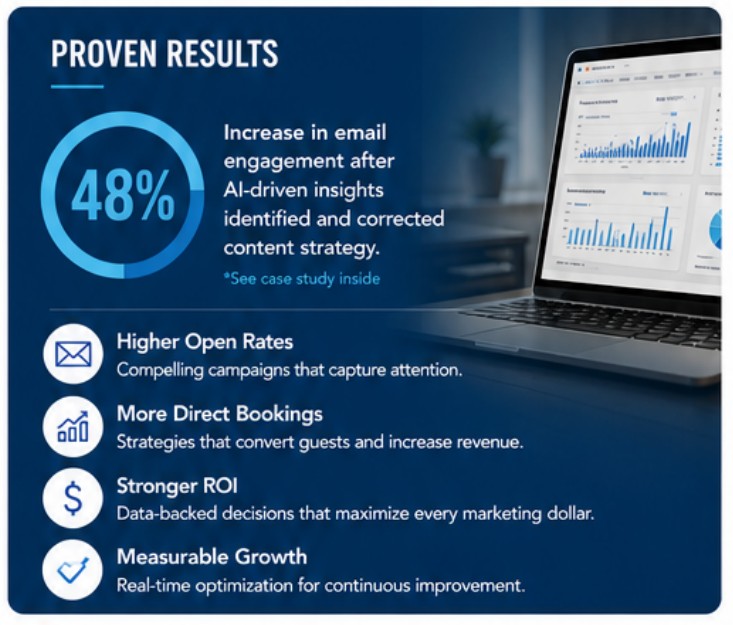
Using AI-assisted reporting analysis across Campaign Monitor and GA4 data, Bluetent identified a significant decline in engagement following the change. Click rates dropped nearly 48 percent after featured listings were removed.
The analysis helped connect the content shift directly to the performance decline, giving the client a clear, data-backed recommendation. After reintroducing featured properties, engagement rebounded.
From Linear Workflows to Connected Systems
Traditional marketing workflows are often siloed and sequential: export data, analyze reports later, draft recommendations separately, and troubleshoot technical issues in isolation.
AI-enabled workflows change that model.
By layering automation and AI analysis into reporting, integrations, and strategic refinement, marketing teams can move faster from discovery to action. Insights surface earlier, recommendations become more consistent, and decisions are grounded in connected data rather than fragmented systems.
The Real Advantage of AI in Marketing
AI is not replacing strategic marketing teams—it is helping them move faster, uncover deeper insights, and make smarter decisions.
Most teams start with content generation. The real advantage comes from using AI to automate reporting, break down data silos, improve personalization, and accelerate the path from raw numbers to strategic action.
When automated workflows are combined with experienced human judgment, marketing organizations stop reacting to performance and start proactively shaping it.
From AI-assisted reporting and automation to evolving SEO strategies built around topical authority, Bluetent is helping vacation rental companies prepare for the future of digital marketing.
 Your Privacy Choices